
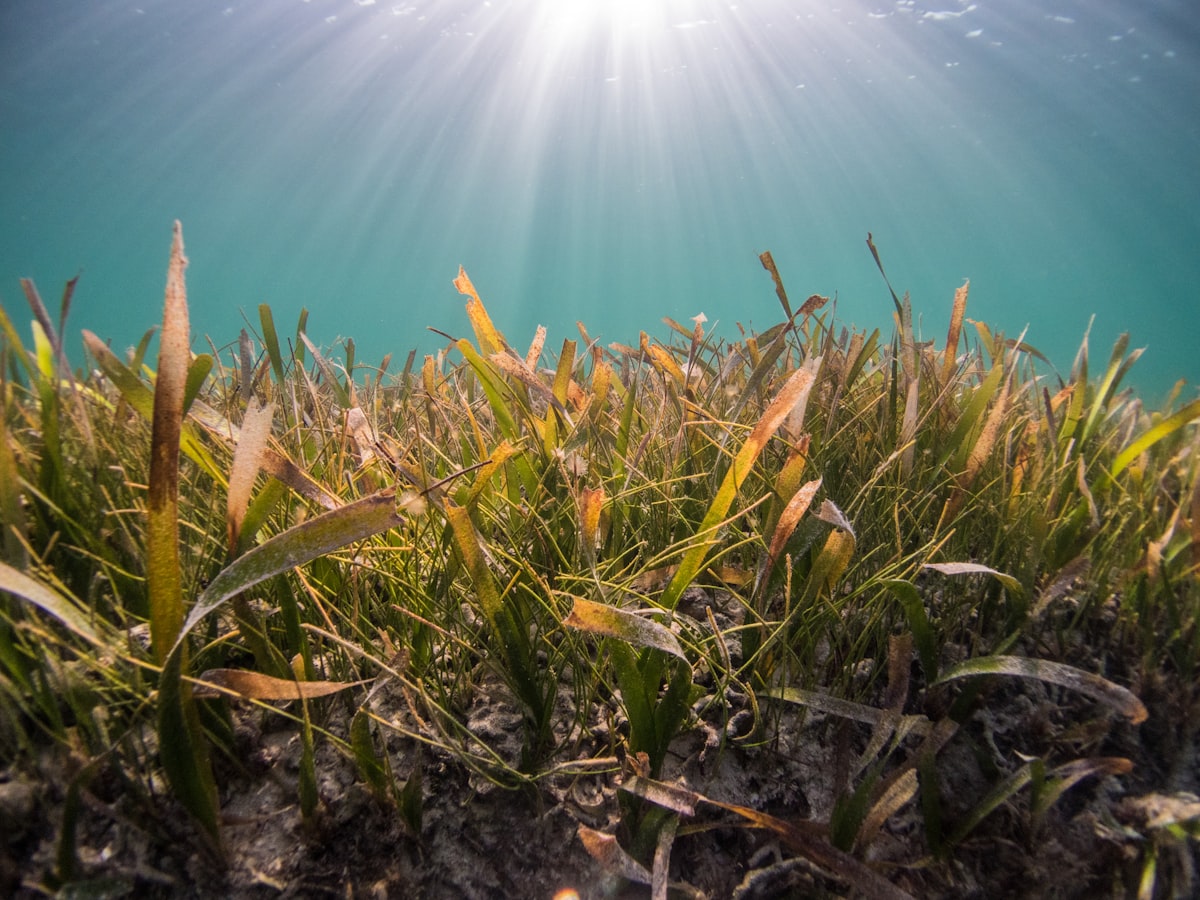
Seagrass meadows and the climate share a vital relationship that most people overlook. These underwater prairies, made up of flowering plants that colonized coastal seabeds millions of years ago, are among the most productive and valuable ecosystems on the planet. Under threat on every front, they deserve the same urgent attention we give to tropical rainforests. 🌿
Seagrass meadows and the climate: extraordinary carbon sinks
Seagrass meadows (Posidonia in the Mediterranean, eelgrass in temperate regions, tropical seagrass beds) are true champions of carbon storage. Despite their small footprint (less than 0.2% of the ocean’s surface), they store about 10% of the organic carbon buried in marine sediments each year. Per unit of area, their storage capacity is 35 times greater than that of tropical rainforests.
This carbon is stored both in the living biomass of the plants and, above all, in the organic sediments that have built up beneath the meadows over thousands of years. In a Mediterranean Posidonia “matte” (the thick mat of roots, rhizomes and trapped sediment), these deposits can reach several meters deep, locking away organic carbon that is centuries old. Destroying a meadow releases this stored carbon, turning a sink into a source of CO2 emissions. As with mangroves, preserving seagrass is a climate strategy in its own right.
Irreplaceable marine nurseries
Seagrass meadows are a fundamental nursery for marine biodiversity. Their dense leaves and rhizomes create a maze of microhabitats offering shelter, food and breeding grounds to a multitude of species. Studies estimate that more than 20% of the world’s fisheries depend on seagrass meadows at one stage or another of their life cycle.
In the Mediterranean, Posidonia meadows are the nursery of choice for most commercial fish species: sea bass, sea bream, red mullet and other sparids. Seahorses, pipefish and other fragile species find the structured habitats they need there. Seagrass meadows also produce large amounts of oxygen and organic matter that feed the entire surrounding coastal ecosystem.
An alarming state of conservation
Despite their importance, seagrass meadows have lost about 29% of their global area since the 1880s, and the decline is accelerating. In the Mediterranean, Posidonia meadows face several cumulative pressures: careless anchoring by pleasure boats, illegal trawling, coastal water pollution from farm and urban runoff, murky water caused by soil erosion, and warming seas.
Trawling, although banned over seagrass meadows in Europe, still goes on illegally in some areas. Undersea cables and pipelines laid without care can slice through large patches of seagrass. Building ports and coastal facilities destroys meadows outright, sometimes with no compensation or restoration.
Posidonia in the Mediterranean: a sentinel species
Neptune grass (Posidonia oceanica) is endemic to the Mediterranean and found nowhere else. It is considered a sentinel species for the health of the Mediterranean: its presence, density and condition faithfully reflect water quality and the health of the coastal ecosystem. It grows extremely slowly, just 1 to 2 cm (under an inch) a year, which makes it especially vulnerable: a destroyed patch will take decades to recover.
Posidonia forms “banquettes,” banks of dead leaves washed up on beaches, which coastal towns sometimes unwisely remove for aesthetic reasons, stripping away the natural protection they provide against beach erosion. Yet these banquettes are important habitats for many shoreline species, and removing them weakens natural beaches.
Protecting and restoring seagrass meadows
Protecting seagrass starts with reducing the pressures that threaten it. Mooring your boat at organized anchorages equipped with permanent moorings rather than dropping anchor, cutting sewage discharges and farm runoff in coastal areas, and respecting clearly marked Posidonia protection zones: these are all habits we cover in our guide to responsible coastal tourism.
Seagrass restoration programs are underway in several countries. Eelgrass cuttings are being transplanted into degraded areas, with encouraging results in the North Atlantic. In the Mediterranean, restoring Posidonia is trickier because of its slow growth, but promising trials are being carried out, notably off Corsica and in the Ligurian Sea. These restoration efforts, combined with better protection of existing meadows, are essential to preserving these irreplaceable ecosystems.