
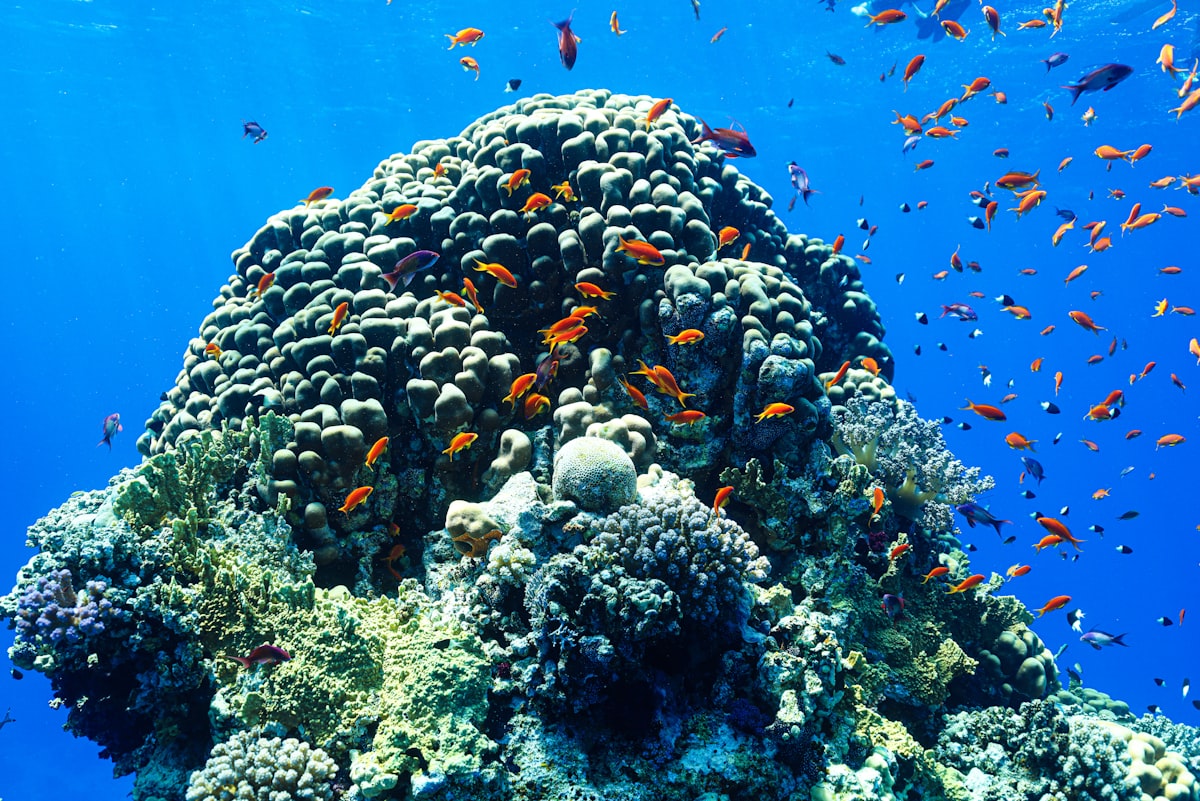
Artificial reefs for marine biodiversity are drawing growing interest around the world. As natural reefs degrade — from coral bleaching, pollution and bottom trawling — the idea of building artificial structures that can host and sustain marine life looks like a promising solution. But does it actually work? And in which settings does it make sense? 🌊
Artificial reefs for marine biodiversity: what are they?
An artificial reef is a submerged structure designed to replicate the ecological functions of a natural reef: providing a hard surface for sessile organisms to attach to, creating shelter for fish and invertebrates, and boosting biodiversity and fisheries productivity. The materials used vary widely: specially formulated concrete, metal frames, composite modules, natural limestone reefs, and — more controversially — sunken ships or aircraft.
The idea is not new — Japanese fishermen have been sinking stones and branches to attract fish for centuries. But scientific artificial reef programs took off in the 1960s and 1970s, first in the United States and Japan, then gradually worldwide. In France, the Provence-Alpes-Côte d’Azur region on the Mediterranean coast has submerged several hundred artificial modules since the 1980s.
The scientific results: a mixed picture
Scientific studies on the effectiveness of artificial reefs paint a mixed picture. When it comes to attracting biodiversity in the short term, the results are generally positive: submerged structures are quickly colonized by algae, invertebrates (mussels, sponges, anemones, sea urchins) and fish that find shelter and feeding grounds there. Species that had disappeared from an area can return thanks to the new structures.
But the fundamental question is whether artificial reefs actually create additional biomass in an ecosystem, or merely concentrate fish that already existed elsewhere — the so-called “fish aggregating device” effect. If an artificial reef draws fish from a neighboring area without producing new ones, it can make them easier to overfish without helping stocks recover. This distinction is crucial to assessing how useful they really are.
The best results: when the conditions are right
Artificial reefs deliver their best results when paired with complementary protection measures. Placed in marine protected areas where fishing is regulated or banned, they can genuinely help rebuild marine populations — the fish they attract can breed without being caught, increasing the ecosystem’s total biomass.
Design also matters a great deal. Reefs with complex geometries, full of cavities and microhabitats, are far more effective than simple, flat structures. Materials that let water flow through encourage filter-feeding organisms to settle and grow. Natural limestone reefs are chemically more compatible with the marine environment than ordinary concrete.
The controversy over sunken ships and planes
Sinking decommissioned ships or aircraft as artificial reefs is a widespread practice, especially in the Caribbean, Florida and the Red Sea. These massive structures offer large volumes and create spectacular underwater landscapes that attract divers — generating significant tourism revenue. But they raise serious environmental questions.
Sunken ships, even after cleanup, can leach heavy metals, residual oils and other pollutants into the marine environment over the long term. Decontamination beforehand is expensive and rarely complete. On top of that, drawing large numbers of divers to a single site can cause significant disturbance — anchoring, noise, handling of marine life — that offsets the expected ecological benefits. That makes responsible diving especially important at these sites.
3D-printed reefs: a promising new generation
As we discuss in our article on green marine technologies, 3D printing is opening up new possibilities for artificial reef design. Modules made of ceramic or synthetic limestone, printed with geometries that faithfully reproduce the architectural complexity of natural corals, are being tested in several regions of the world. These structures offer ideal surface area and roughness for coral larvae to settle and invertebrates to colonize, while avoiding the chemical pollution problems of metal or concrete.
In the Mediterranean, in Marseille and Monaco, pilot projects using 3D-printed limestone reefs are showing encouraging results in terms of how quickly they are colonized and how diverse the species that move in are. These approaches, still small in scale, could eventually complement efforts to restore damaged natural coral reefs.
Conclusion: a complementary tool, not a miracle cure
Artificial reefs are a useful tool in the marine restoration toolbox, but they cannot replace the protection of natural habitats. They are especially relevant for creating habitat where natural hard substrates are lacking, for compensating for habitats destroyed by industrial activity, and for creating dive attractions that give marine protection economic value. But without cutting overfishing, pollution and climate change, no artificial reef will ever restore truly healthy marine ecosystems.